
When Memory Split Into a Before and After
Last July, As‑Suwayda was entering one of its heaviest moments, when tensions turned into a military attack that struck the city and its towns, its echoes reaching inside homes. Within a few days, the rhythm of life changed, and fear became part of the everyday scene — with the sounds of shelling, the movement of displacement, and the anxiety that crept into the smallest details.
What happened in those days settled as a dividing mark in the memory of the people, splitting the sense of time into a clear before and a different after, and reshaping the relationship with safety. Since then, fear has not been a passing state, but a resident feeling — appearing in anticipation, in the questions repeated silently.
This text approaches that experience as it lives in the collective memory today, trying to convey people's sense of this fracture, and to trace how what happened has turned into a persistent preoccupation — returning with anything that resembles it, and settling deep inside.
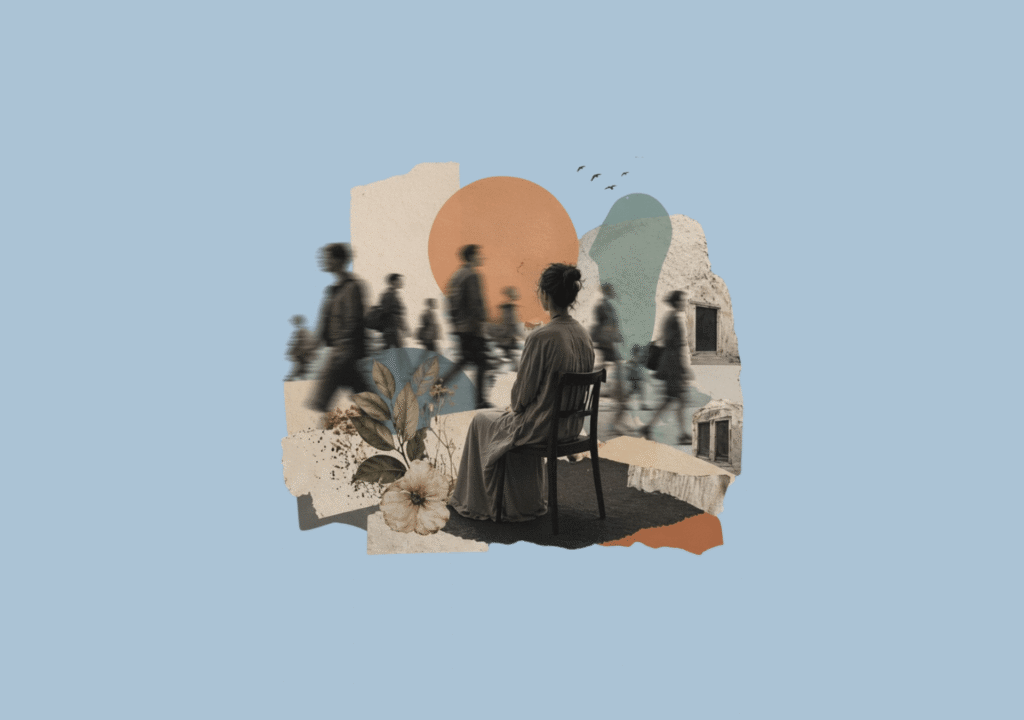
"That day has not ended for me. Every detail of it is still present. Sometimes I feel that I am still there, in the same moment."
— One of the women
Last July, fear was not just news to be passed around — it was an experience people lived inside their own homes.
In that black July, As‑Suwayda was not facing a passing event, but a harsh moment of invasion that broke the rhythm of life and placed an entire community before a fear not previously known in this form. In those days, violence entered homes, and simple daily details turned into spaces of anxiety and anticipation.
The question was no longer:
What is happening? … but rather: Are we safe?
What happened was not merely a series of isolated events, but a collective experience that left a deep mark — still present today in memory, in feeling, and in the way people see their lives. July has not remained a passing date in the memory of As‑Suwayda; it has become the name of an open wound.
An experience that reshaped the sense of life, safety, and meaning. Today, when people speak, they do not speak only as individuals, but as a community carrying a shared memory. One says:
"We are no longer as we were — even those who lost no one have lost something inside themselves."
Another adds:
"The pain is not only in what happened, but in the continuation of its effect — in the fear that remained, and in the questions left unanswered."
This voice is not the voice of one person, but an echo repeated in many homes, in hushed conversations, and in long silences.
Behind this collective voice lie individual testimonies, carrying details that cannot be ignored.
One of the women says:
"That day has not ended for me. Every detail of it is still present. Sometimes I feel that I am still there, in the same moment."
A man who lost a family member recounts:
"We were living a simple life. We never expected everything to change so quickly. Loss is not just the absence of a person — it is the loss of an entire sense of stability."
In another testimony:
"There are things we saw… and things we heard… and things we cannot even name. But all of them left a mark that does not fade easily."
A mother speaks in a tired voice:
"The fear for the children has not ended, even after time has passed. Anxiety still accompanies us in every moment."
These testimonies — though fragmented — reflect a wider reality: a community that faced a deep trauma and is still living its consequences.
As‑Suwayda today is neither a place fully recovered, nor a place completely broken — but a space between the two, trying to restore its balance, to understand what happened, and to find a way to carry on. And despite everything, there is a clear insistence — not on forgetting, but on survival.
The collective voice says:
We are here. We carry what happened. But we are also trying to live.
What came after July is not just a phase of time — it is a long test of memory, of the ability to hold together, and of what it means to be part of a community that has suffered a trauma. And perhaps in gathering these voices — individual and collective — one truth emerges: that pain, when told, does not disappear, but becomes more understood, and less alone.