
The Door of the House Is Red
This text is a testimony about what remains after massacres, when the search for the missing becomes an attempt to identify people through the last trace they left behind. It is about villages left suspended between displacement and death, and about memory when it turns into a torn piece of paper, a colored door, or a name that no one can fully reclaim anymore.
Faces turn into shadows, and bones become silent signs that someone was once here.
— Waed Abu-Saed
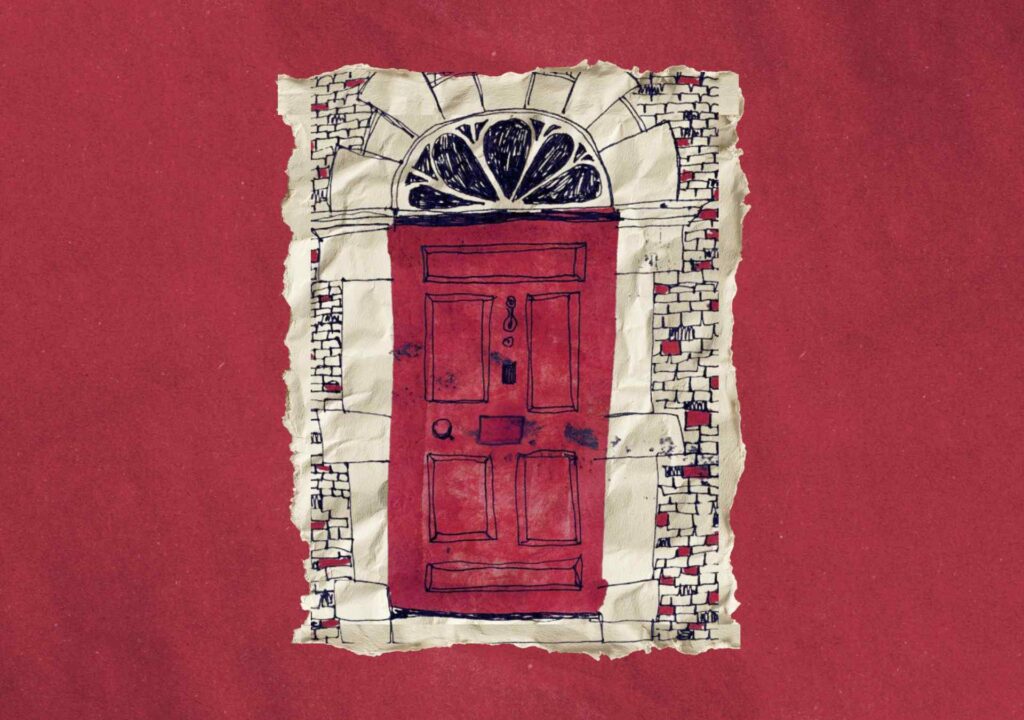
“First road to Al-Mazraa, opposite the asphalt factory… The Door of the House Is Red.”
A short sentence written on a worn-out piece of paper — all that remained of a human being.
No name, no photograph. Only a final trace hanging between life and death.
The scrap of paper was the clue to a decomposed body and torn clothes, found in the town of Al-Mazraa — a town emptied of its inhabitants, its houses turned into hollow shells, where only the whistle of wind and the memory of blood could be heard.
Even today, teams from the Red Crescent in Syrian Arab Red Crescent are still barred from entering some of the devastated villages in the north and west. Instead, teams from other cities are called in — unfamiliar faces retrieving the bodies of the local people weeks after the invasion and displacement.
Sixty days after the massacre, death is still at work — slowly.
Body recovery operations move step by step, while corpses decompose under the sun and are torn apart by animals. Faces turn into shadows, and bones become silent signs that someone was once here.
Just yesterday, an unidentified body arrived from the exhausted town of Al-Qurayya, along with six others found inside their homes — as if they had been waiting for the final knock on the door.
In one house, an entire family was found: a man, a woman, and two children, burned alive inside their home.
They were not identified until fifty days later, when a volunteer was led to the place by something resembling the final scent of life.
The walls, furniture, photographs — even names — had all burned away.
Only silence remained, dense and filling the space.
The two images circulated on Saturday morning, September 13, were from Al-Mazraa itself: another unidentified body, and a house without a door.
Just one day earlier, the transitional authority had announced the “rehabilitation of the town’s bread oven,” inviting residents to return, saying:
“Your homes are waiting for you.”
But what home is waiting, while homes themselves are still retrieving their dead?
How can a person return to a place that has not yet finished burying its people?
That same morning, another decomposed body was found on the outskirts of Al-Qurayya, transferred to Al-Suwayda National Hospital, without anyone being able to identify it. The features had almost completely dissolved, as if time itself had decided to erase even the last witness.
A healthcare worker in As-Suwayda says:
“More than thirty bodies have arrived from Damascus to the forensic medicine department in As-Suwayda.”
Some families identified their children from faint features in a photograph. Others will remain unknown — like the owner of the first scrap of paper, who was left behind with only one sentence:
“The house door is red.”
“The Door of the House Is Red.”