
The Memory of Coexistence and Social Transformations
The old alleys of Damascus carry a social memory that goes beyond the physical shape of the place itself, holding the stories of the people who once lived there and the transformations of the city over time. Among these alleys, "Al-Riyashna Alley" in the Bab Musalla area stands out as one of the places linked to the history of migration, settlement, and social diversity in Damascus during the second half of the nineteenth century.
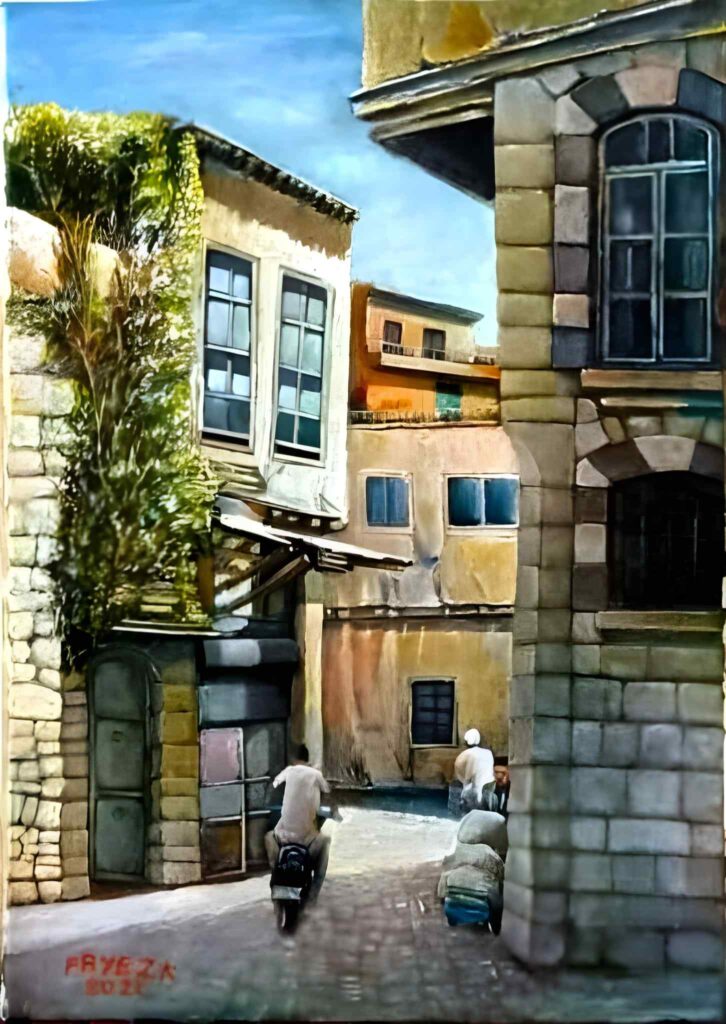
Painting dimensions: 50x60
Medium: Acrylic on canvas
This painting revisits the scene of "Al-Riyashna Alley" as it appears today in the twenty-first century, drawing on the historical background of the alley, which was established in the Bab Musalla area of Damascus in 1860, during a period that saw a number of families moving from Lebanon to Syria. The name of the alley is associated with the Lebanese town of Rashaya al-Fakhar, as several families from that region settled there, including Christian and Druze families who found in Damascus a new place for life and stability. Historical accounts suggest that Abdel Qader al-Jaza'iri, who resided in the Midan district after being exiled from Algeria, played an important role in helping the newcomers and securing housing for them near Bab Musalla, which later led to the emergence of the alley known as "Al-Riyashna Alley." The painting focuses on the visual and social memory of the place, presenting the alley as part of the popular Damascene fabric that has preserved its social and religious diversity over time. It also attempts to evoke the relationship between place and identity, and between the old architecture and the stories that remain present in the memory of the area's residents to this day.