

Layers of the City
This text is an attempt to read the city from within its transformations rather than from the outside. It is about a place whose appearance changes while its old layers remain present beneath the surface, about memory when it becomes either a burden or material to be reshaped, and about how new discourse can appear polished while reproducing the same structure through different tools.
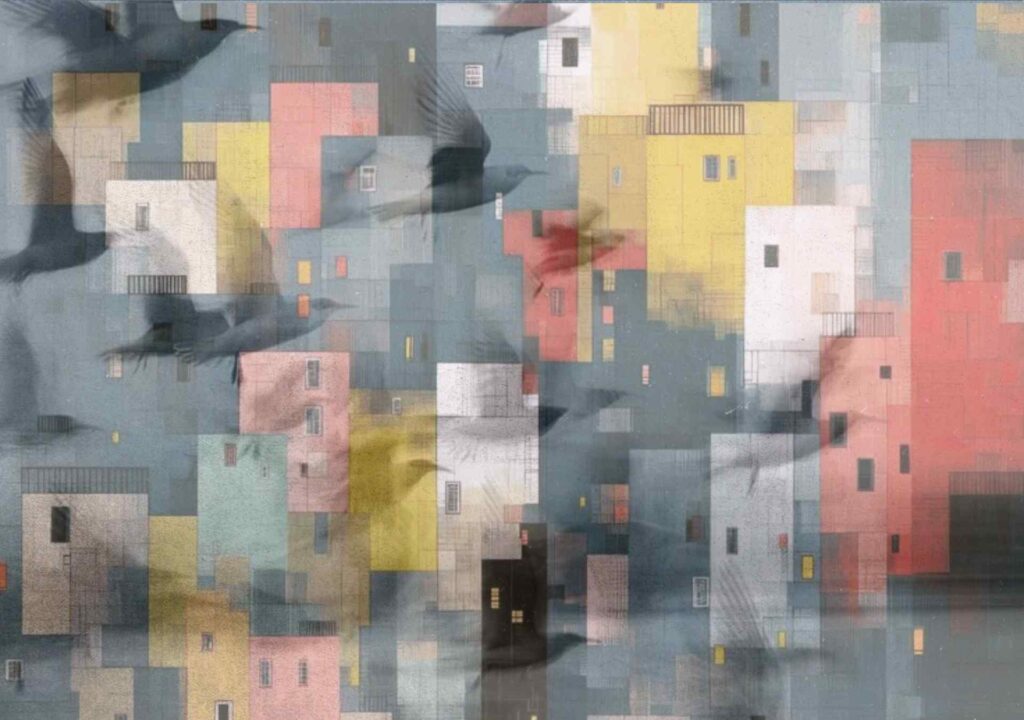
"Not every city really changes — some only grow skilled at rearranging themselves above their own memory."
— Najmah
In a place that keeps forgetting itself, the city curls inward in memory like an old house left without electricity — everything is still in its place, but the light is gone. The faces I once knew have scattered between fear, departure, and exhaustion from speaking. It feels as though the city that once recognized us has disappeared, or shrunk into a corner no one sees anymore.
Today, the city is being reclaimed in a different form. The streets are wider, the cafés more numerous, the faces newer and more diverse. Talk of “projects,” “initiatives,” and “cultural revival” fills every space. And yet, there remains something heavy in the atmosphere, something that makes every step hesitant and turns skepticism toward dominant narratives into a daily instinct. On the surface, the city appears renewed, but deep within, it remains governed by a memory that has neither been forgiven nor erased, only rearranged to fit the new scene.
Over recent years, a new layer of public figures has emerged in the city — people presenting themselves as initiative leaders, project managers, and experts in development and civil society. A soft and polished language now fills the public sphere, creating the impression that the city has moved beyond its crises into a more mature and organized phase. Yet beneath this image lies a deeper complexity. Many of these faces are not truly new, but extensions of older networks of influence and interest that have simply reproduced themselves under different labels.
Today, few people pause to examine those roots, as though the city has entered a large-scale process of whitening that extends beyond public image into memory itself. Individuals who were once part of systems of exclusion, or who remained silent during critical years, now speak the language of transparency, advocacy, and empowerment. The discourse has changed, but positions of power have not changed to the same extent. Even contradictions themselves no longer raise many questions, but instead pass quietly as part of the “new phase.”
Language itself has become a tool for organizing reality. Terms such as “partnership,” “funding,” and “sustainability” are no longer merely technical vocabulary, but soft coverings for more complex structures of influence. Beneath this discourse, the same feeling persists: that opportunities continue to be distributed within specific circles, and that those capable of adapting to the language of institutions are the ones capable of remaining within the scene.
The city once known for its open discussions and simple critical spirit has now become a space of small conferences and oversized banners, where words turn into façades and people into temporary audiences for an ongoing performance about “local revival.” Yet this image only exists in public. Once the doors close, everything returns to its original structure: influence for those with connections, and marginalization for those who possess nothing but memory.
Within this context, memory itself becomes an unwelcome burden. Remembering old details means disrupting the unspoken consensus surrounding the city’s new version. Those who recall the past are often viewed as unable to adapt, or as obstacles to the discourse of “progress.” Over time, silence no longer comes only from direct pressure, but from the exhaustion of repeatedly explaining what no longer seems important to anyone.
And so, space is left for those who possess the tools of discourse to write their own narrative about the city — a polished, organized narrative free of contradictions. With repetition, that narrative gradually becomes something close to the officially accepted reality, while everything outside it is pushed toward the margins or into oblivion.
The irony is that all of this is presented as a sign of recovery. People say the city is moving again, that public life is regaining its energy. Yet the question remains suspended: what kind of recovery is built upon the exclusion of memory? And how can a society speak of change while reproducing the same structures under different names?
Perhaps the problem is not change itself, but the way it is narrated. When transformation is reduced to polished façades and refined discourse, change becomes more cosmetic than structural. And when memory becomes a burden, everything that falls outside the approved narrative becomes vulnerable to exclusion or suspicion.
In the end, the conflict within the city no longer appears to be a struggle between old and new as much as it is a struggle between a memory trying to remain present and a discourse attempting to reshape what is allowed to be remembered. Between the two, the city remains in a constant state of rewriting, where it is never entirely clear whether it is truly changing, or simply becoming more skilled at changing its appearance.