
What Comes After Survival Is Not Survival
In the period that followed the fall of the regime, new signs of instability began to emerge along the Damascus–Suwayda road, with repeated incidents of looting and abduction, and a growing sense of anxiety among residents.
In our village — relatively distant from those tensions — that fear began to seep gradually into the fabric of daily life. It reshaped our sense of safety and, at times, pushed us into temporary displacement toward the city, only to return at the first sign of calm.
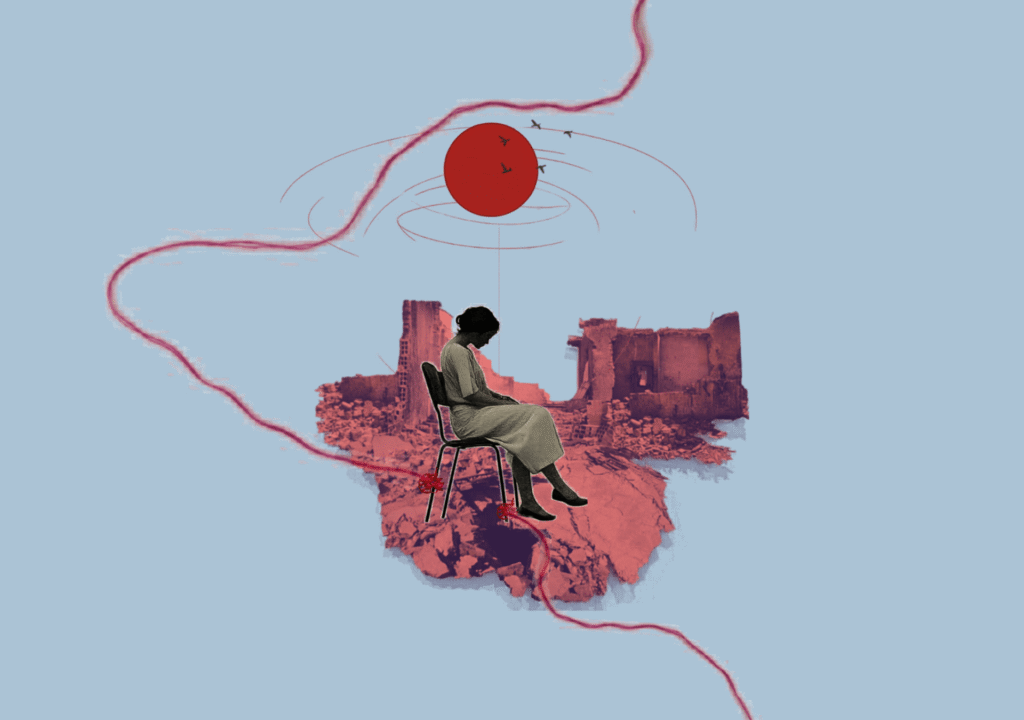
In that moment, the world shrank into a single idea: to stay alive.
— Kristine Al-Shoufi
A Deceptive Calm
My home lies at the very edge of Sweida province, at the junction of Taara village in the western countryside, on the administrative border with Busra al-Harir in Daraa province. It is the farthest house from the rest of the village.
Our region has long experienced a form of coexistence with neighboring Bedouin tribes, which granted it a relative calm despite recurring tensions — especially in recent times, when village residents organized rotating guard shifts at the checkpoint in anticipation of any emergency. With every escalation, we would leave temporarily, then return.
But what happened at dawn of 14 July 2025 was entirely different…
After midnight, around 3:30 a.m., the young men of my village returned from the borderlands near Daraa following tensions in nearby areas, among them my brother, the journalist Sari Al-Shoufi. The night was unnervingly still — a heavy calm that precedes something unseen.
Nearly an hour passed before villagers began noticing a luminous convoy approaching from the direction of Busra al-Harir. The moving lights in the darkness were not ordinary; they were enough to awaken a buried sense of alarm.
My brother called me urgently, asking us to prepare to leave the house. There was something unfinished in his voice. Then the call dropped. Minutes later, he called again, calmer, saying he had contacted someone in the Ministry of Defense and that the convoy was coming to resolve the conflict peacefully. For a moment, that reassurance settled over the night like a fragile pause.
But the calm did not last.
A sudden explosion struck the checkpoint, tearing the silence apart. Later I learned it was a weaponized drone that had begun firing. Gunfire erupted without pause, and the tension returned heavier than before, filling every corner of the place.
Then the phone rang again.
It was my brother.
This time his voice was different — broken, strained:
“I’ve been hit… they’re here… may God protect you.”
The line went dead. His voice remained suspended in the air, refusing to disappear. And I stood there between my mother and sister, trying to hide what I had just heard, as if concealment could delay what was already unfolding.
Searching for Shelter
Barely minutes later, everything collapsed.
Gunfire intensified, closer, heavier, until bullets began piercing the walls and windows of the house. There was no time to think. We ran into the bathroom, as though it could offer protection, searching the ceiling for an illusion of safety.
We were trapped inside fear. Only instinct remained.
Then violent knocking struck the back door.
A panicked voice:
“Get out… maybe we can survive.”
We ran out as we were, leaving even the prepared bag behind. We hid behind the house for seconds while gunfire continued. Then we ran again — across rough terrain, without direction, only escape.
We reached an agricultural well and took cover. Bodies shaking, breath breaking. Explosions filled the air. The ground itself felt unstable.
I tried calling anyone — friends, acquaintances, the Red Crescent. No answer. No one could reach us.
The young man with us ran to bring his car. He left… and never returned. We could not wait.
We ran again under the July sun, smoke rising from every direction. Open land — no walls, no trees, no shade. We crawled across dirt and stones while bullets passed above us.
In that moment, the world shrank into a single idea: to stay alive.
We later reached a small room belonging to a farm worker from Deir ez-Zor. We stayed only seconds — seconds that felt longer than everything before them.
The watchman gave us water. Outside, the sounds always arrived before meaning could form. Reaching another village was no longer possible; the road itself had become danger.
We moved with him toward a nearby house where his wife and children were. We sat together in a tight silence, trying to convince ourselves of safety, while something inside us refused belief.
Around two in the afternoon, a dense, oppressive silence fell — the kind that feels like the pause before collapse. It did not last.
A single shell struck the wall behind us and tore through it as though it were paper. Time froze. Then returned in fragments. No one was injured, but the realization was heavier than injury itself: walls no longer protected anything.
Return of Terror
Minutes later, violent knocking struck the door.
Not a request. Not hesitation. An entry before entry.
We froze.
Abu Mohammed, the watchman, stepped forward slowly. The door opened.
They entered immediately.
More than twenty men in black uniforms bearing the insignia of General Security. The space filled in seconds, as if the air itself had changed. They spread through rooms and corners, taking control of sight and space.
Sharp voices. Fast questions. No room for answers.
We sat on the floor — my mother, my sister, and I — wrapped in a blanket, trying to shrink, to disappear. ID cards were demanded. Who are you? Why are you here? Where are the rest of your family?
Words collapsed before reaching speech. Silence became our only response.
The looks alone were enough to shatter what little composure remained.
The watchman and his wife spoke for us, trying to calm them… and us. Hospitality was offered, as if it could soften the moment.
Then one of them said, coldly:
“Do not be afraid… we are here to protect you.”
The sentence passed over us without meaning.
Then he pointed at me:
“You. Come with me.”
I rose. I don't recall how my legs carried me. I walked behind him into a side room. The short path felt longer than all the ground we had covered in our escape. In those steps, every dark possibility flashed through my mind at once — a swift end, or a slower one. He sat on a chair and motioned for me to stand before him. He asked for the names of the nearby villages. I tried to answer. The words wouldn't come. The names had faded, the directions muddled. I told him I needed to see the road in order to explain.
He grabbed my hand firmly and pulled me outside. He pointed toward the road, demanding that I identify it. I mumbled the names of the villages, my voice barely audible, my heart pounding in my chest as if it were trying to escape before me.
Inside, they were still searching the house. They opened everything, turned everything over, and gathered whatever could be carried. It wasn’t just a search — it was an uprooting of whatever was left of the place. Hunting rifles were taken, birds from their cages, and even the dogs outside were not spared. We stood watching in heavy silence, trying not to draw attention, as though any extra movement might change our fate.
Time passed heavily, indistinctly. Then, just as suddenly as they had entered, they left. Behind them, they left a suspended chaos hanging in the air. Before leaving, they ordered the watchman to leave a light outside, so that the house might appear occupied.
The Onslaught of Fear
Evening fell slowly, as if examining what remained. We tried to catch our breath, to convince ourselves that the worst had passed. But the knocking on the door returned once more. This time, it was not sudden… it felt like the return of the very end itself, in another form.
But what came next was not an extension of what had preceded it. It was heavier — closer to something resembling a complete collapse.
This time, they did not arrive in uniform, nor with familiar faces. The sound of their footsteps was different from the very beginning — as if they were not passing through a place but storming it. We did not see them directly; we were inside a closed room. But the sounds alone were enough to fill the walls with terror. Noise, orders, and a tone that left no room for retreat.
The watchman tried to approach them. His voice sounded weaker than his plea, attempting to calm whatever could be calmed, and to convince them not to come in to us. He said we were relatives of his wife, and that we had left at dawn in a hurry, without head coverings. We could hear everything from behind the door. Each sentence pulled the air out of the room and left us more exposed.
Inside, the question needed no words. What if they entered and discovered the truth? What if everything changed in a single moment? The questions kept moving inside the head with no answers, while the outside silence pressed harder than any sound could.
We had nothing left but to stay still. To hold back our tears so they wouldn’t turn into evidence against us.
That night was not sleep. It was a broken, intermittent loss of consciousness — caught between waking and fear, between silence and trembling. And with the first light, morning did not come as we knew it. Instead, the sound of a vehicle roaming the village arrived, carrying loudspeakers. Quranic recitations, and a man’s voice rising above them:
“This is your fate, you infidels… This is your fate, you pigs.”
The voice was not merely a threat. It was a declaration that the night had not yet ended, and that what had begun inside the houses had spilled out into the street — without borders, without a clear end.
We tried to reach anyone who could help us. Every attempt ended in a silence longer than the one before it — as if the world itself were stepping backward, one pace at a time.
After a while we could no longer measure, we reached a friend of my brother’s, and through him, someone who said he could get us out of the village toward As‑Suwayda. At that moment, everything changed. The question was no longer: will we get out? It became: how do we wait without falling apart?
An Uneasy Path
The hours passed with suffocating slowness. Staying was not safe, and leaving was no less dangerous. We were in the gray distance between the two — where no decision protected, no choice reassured — only an open anticipation of the unknown.
As evening fell, after repeated attempts to describe the place to whoever would come, a car appeared. We could not see clearly who was inside. The light was dim, the faces unreadable. The silence that accompanied the moment of climbing in was heavier than any question — as if what was happening carried no clear definition: a belated rescue, or the beginning of a new trap.
We sat inside the car. Quick, hesitant glances passed between us and the driver, who wore a military uniform. No one asked, no one explained. The road took over everything and began pulling us toward an incomprehensible destination.
At the village checkpoint, the scene shifted again. The right side was completely destroyed — no trace of those who had once stood there. And on the left, our house… or what was supposed to be our house, but its features were no longer clear. We didn't know whether it still looked as we had left it, or had become something else.
We stopped, and then came the order: move to another car. We got in.
The new car belonged to one of the General Security commanders, Mohammad. At that moment, there was nothing in us that resembled trust. The decision felt more like surrender to what was unfolding, nothing more.
The car set off. The roads we traveled were no longer roads, but open expanses of ruin. Every scene said that what had happened was larger than a clash — that what we were seeing was a complete collapse of a landscape we had once known.
At first, we didn't speak. We only watched through the windows, as if silence could explain what was happening. The road was gradually moving away from As‑Suwayda — but not with a reassuring slowness. Rather, with a clear deviation that grew more certain with every kilometer.
Then realization came all at once.
This is not the direction.
As‑Suwayda is behind us… and Daraa is ahead.
In that moment, everything turned upside down. The air inside the car grew heavier, the space tightening as if closing in on us. The tension that had been silent erupted at once, transforming into a single question pressing on every movement: Where are we going?
Our voices rose for the first time, then grew louder. We asked to stop, again and again — but the road continued, as though nothing could be heard inside the car.
“Stop… stop the car.”
The voice came out fragmented but then became clear, repeated as a plea charged with fear — a last attempt to regain a direction that had slipped out of control.
But the car did not stop.
In those minutes, the fear was not just of the road — but of the idea that the road itself was no longer reversible.
We arrived at the family home in the town of Al-Karak. We were welcomed there with open arms, as if the door that opened for us in that moment was trying to restore some balance to the world. Water and food were offered to us, and the sound of people around us seemed less harsh, less hurried, less fearful. For the first time in many hours, we sat without the sound of nearby gunfire, without the movement of flight, without the need to hide behind anything.
But calm did not fully reach us.
The body was in one place, the mind in another. Everything appeared still from the outside, while inside silently burned. The moment was like a brief pause inside a storm that had not yet ended.
We stayed there for two days and three nights — trying to understand what had happened, and trying even harder to understand what might happen next. News came fragmented, contradictory — nothing offered certainty. Each account opened a new possibility for anxiety, nothing more.
But the real anxiety lay elsewhere.
My brother.
His presence was absent from every report, yet never absent from any thought. I tried repeatedly to reach him. I asked the man who had brought us to search for him in the hospitals of Daraa. The request felt closer to a plea than a question. I was searching for any sentence that could disprove what was running through my mind — any news that could rearrange fear to a bearable level.
There was nothing clear. No confirmation, no denial. Only a void that left every possibility open.
The Voice of Absence
On the morning of the third day, Mohammad came. He said we had to prepare to return to As‑Suwayda. It seemed that the situation outside was changing quickly. The General Security forces had pulled out of As‑Suwayda, and the clans were preparing to move in. We knew nothing of that, but he said that staying in Daraa might trap us further, with no way back later.
The calm we had begun to cling to receded in an instant. The place was no longer safe — only a temporary stop between two fears. And with the new decision, the same question returned with greater weight: Where is my brother now, and where might fear reach this time?
We arrived at what was called the “Driving Center,” about one kilometer from the village of Ta’arah on the Daraa side. He stopped there, then said with cold calmness:
“I cannot go any farther than this point.”
That sentence brought back something we had never really left behind. Fear returned all at once, as if it had only been waiting for a signal. We got out of the car, but we did not get out of the tension. The running began again — no clear direction, only a search for any road that might bring us back to someone, anyone.
We reached my uncle after great effort. He was the only hope left in that moment. We tried desperately to get to him because he had a car — the only option that could open a way back to As‑Suwayda.
But the return was not a return in the simple sense of the word. The road linking the village to the city was no ordinary passage. From the very first moment, it felt like an independent chapter of the catastrophe. On its sides, unforgettable scenes: corpses lying on the ground, burned houses, looted shops, dead animals in their places. The smoke was not just a trace — it was a layer covering everything, and the smell of blood was so present it made the air itself heavy. Every meter carried a new image of collapse. The road was not leading to a place… it was passing through the heart of the disaster.
And when we reached As‑Suwayda, the place looked familiar from the outside, but we did not feel that we had fully returned. There was a kind of surface safety — a less harsh silence, familiar faces — but deep inside, something remained stuck on the road, between what had happened and what had not yet been understood. We were in a place that was supposed to be safe, yet the search inside us did not stop for one answer: Where is my brother?
I did not know that our last call — his wishes for my safety and the family’s — was his silent goodbye. At that moment, his voice was ordinary, carrying familiar worry and tenderness. I did not know that behind it, an end was being written quietly.
Days after the massacre, a voice recording of my brother spread on WhatsApp groups, warning people of the attack as it began. He said:
“All the young men with me have been martyred… Get the women out…”
Only then did I realize that this was the last voice I would ever hear from him. Not just a passing piece of news — but the last remaining trace of his presence in the world.
Later, his photo spread. Injured. Published on Telegram channels, accompanied by inciting and degrading words — as if pain were being displayed outside its context, as if a human being were reduced to the moment of their fall alone.
If only they knew who Sari really was. How he spoke, what he did, how he stood in the face of something far larger than the final image they tried to fix of him.