
When Anxiety Calms Down a Little
This is a true story — a brief episode in time, profound in its aftermath — about a family forced to pass through Damascus under harsh circumstances. Through a passing visit, the story reveals how fear settles into children’s behavior, and how something as simple as a short outing in the city can open a temporary window toward reassurance.
The story dwells on the small details of everyday life: silence, hesitation, attachment, and quiet attempts at adaptation — without exaggeration or dramatization — offering an intimate human portrait of how violence and prolonged anxiety seep into ordinary existence. At the same time, it reveals the fragile power of simple moments to restore a measure of balance, however fleetingly.
This is not the story of a grand event, but of a feeling that forms quietly — revealing how fear can seep into the smallest details of everyday life, and how safety, even if only for a fleeting moment, can redefine an entire place.
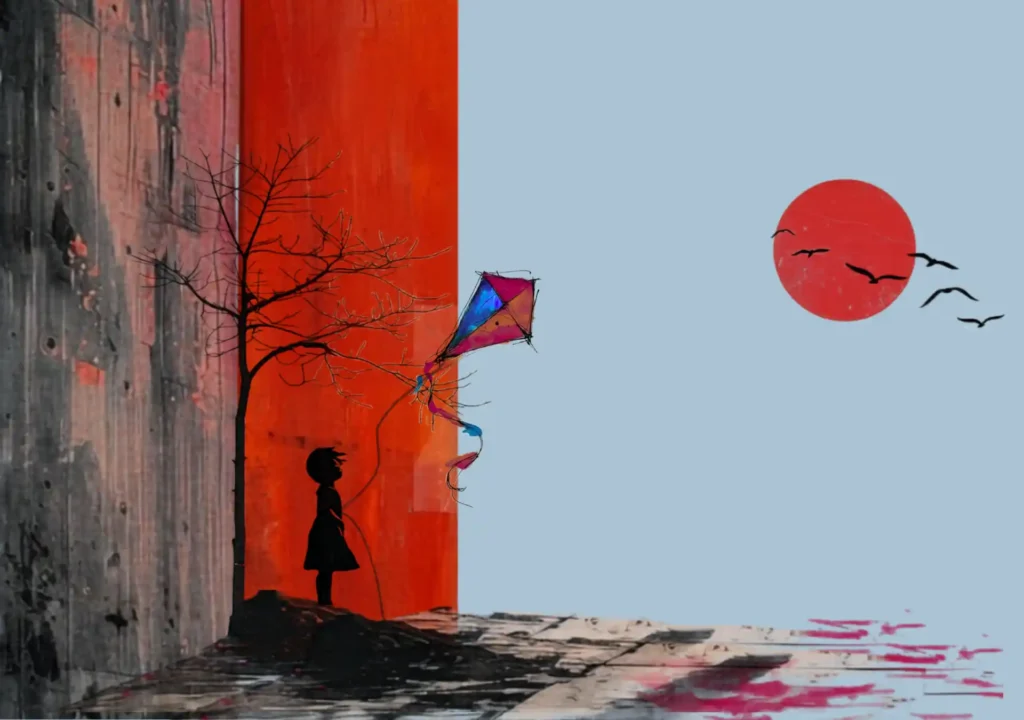
Her only hope was that, one day, they might forget what fear looks like when it settles inside the smallest details.
— Hind Youssef
Perhaps it was the strangest visit my house had ever known — a house accustomed to noise, faces, and stories. Yet something about this visit felt different from the very first moment. Perhaps because my husband and I belong to two different sects, and for years we had tried to live beyond the weight of inherited constraints, content with the unavoidable duties imposed by our small family.
That day, my husband received a call from a relative of his whose name I had never heard before. I had never met her. She told him she was in Damascus, that she had nowhere else to go, and that she needed to come with her three children and spend the night at our home.
She arrived in the evening.
We welcomed her sincerely, but anxiety entered the house before she did — visible in her features, etched into the eyes of her children.
They had come from Sweida.
From a home that no longer existed.
From memories that had burned.
From a life that had shattered without warning, forcing them to seek refuge with relatives in the city.
She had just returned from an exhausting trip to Lebanon for a family reunification interview at the German embassy — a journey carried equally by fatigue and hope.
But everything had unraveled there.
She had been treated harshly; her passport was damaged under the pretext that the photograph was unclear. She had no choice but to rush back to Damascus to obtain a replacement document, instead of returning to Sweida as planned.
Despite our attempts to reassure her, tension remained firmly lodged within her — and within her children.
Their behavior was striking: complete silence, excessive politeness, an almost total retreat into the room we had prepared for them, as though they had taken shelter there from a world they no longer trusted.
The next morning, she left with my husband to complete the passport procedures, insisting that she could not face the city alone. The children stayed with me. I tried making them breakfast, tried gently drawing them into conversation or play. They emerged briefly, took a few hurried bites, then retreated immediately to their room, shutting the door behind them as though the outside world were a lurking danger.
Later, as I watered the plants on the balcony, I called them to help — hoping the small task might distract them. Only the youngest responded. An eight-year-old boy opened the door with hesitant steps. Then his sister’s voice called him back. He returned at once, closed the door tightly. Fear inhabited them in a way that required no explanation.
The following day, their mother returned more relieved. Her paperwork had gone far more smoothly than expected. Yet nothing changed in the children’s behavior. The entire day passed behind the closed door, despite all my efforts to lure them gently back toward life outside that room.
That evening, I suggested we go out for a little while — just to let the children breathe. She hesitated for a long time. She agreed only after repeated insistence and after a chain of phone calls with her husband and family, who checked on her almost every hour.
We finally left. The ice cream shop was nearby; the plan was for nothing more than a short outing. But I suggested we continue to Old Damascus. She was frightened by the idea — by the road, by taxis, by the possibility of kidnapping. Even public transportation felt risky to her. Still, reluctantly, she agreed.
When we reached Bab Touma, the children stepped out and clung to their mother as though they were extensions of her body. Their eyes moved anxiously across unfamiliar faces. They whispered to her in fear:
“Mama… could they know we’re from Sweida and kill us?”
The question alone said everything that words usually fail to carry.
She wrapped her arms around them, terror unmistakable on her face.
We walked through the old alleys.
It was their first visit to Damascus.
I tried to offer them another way of seeing the place.
I invented a story about the filming locations of Bab Al-Hara — their favorite television series.
I pointed here and there:
“This is Abu عصام’s house… here is Abu بدر’s shop… and over there is Mu‘taz’s store.”
I bought them “Mu‘taz’s stick.”
And slowly, something began to shift.
Little by little, they loosened their grip on their mother. They moved closer to me. Wonder widened in their eyes. Questions began tumbling out: Where is the police station? Where is the midwife’s house? The place had begun to resemble a story they knew — not a city they feared.
And when we reached the courtyard of the Umayyad Mosque, the surprise was even greater. The square overflowed with people, children, vendors, laughter. Ordinary to us. To them, another universe entirely.
Children playing at night?
Lights that did not go out?
Young men and women walking and laughing without fear?
We stayed there for a long time.
Then they blended into the scene.
They played.
Ran.
Laughed.
Bought balloons and juice.
I took photographs of them — smiles clear and unguarded, as though they had never carried so much pain.
For a moment… just one moment… it seemed as though fear had stepped aside.
But when it was time to leave, silence returned exactly as before. They wished they could stay longer, stretch that moment a little further — as though they already knew how difficult it would be for such a moment to return.
That night, the children fell asleep quickly. I remained awake with their mother.
And only then did the real door open.
She spoke for a long time: about massacres, about homes that no longer stood, about children who no longer stepped outside, about vanished schools, about nights when the city sealed itself shut before dark, about fear becoming not a passing condition, but a way of life.
She said her children lived inside a single room and rarely left it. Gatherings were no longer gatherings. They had become recitations of the absent — a revisiting of faces no longer there.
And her only hope was Germany. Her husband. Perhaps there, she could save what remained of her children’s childhood. Perhaps she could restore to them some fragment of the safety that had been lost. And perhaps, one day, they might forget what fear looks like when it settles inside the smallest details.