
When Fear Becomes Part of Everyday Life
This text reflects a personal experience written in the aftermath of the violence that took place in Suwayda in July 2025, which was accompanied by attacks and violations affecting civilians and leaving deep humanitarian and psychological impacts on the local population.
The text does not focus on the events as a political or security incident, but rather on their human and everyday consequences, and how fear, survival, and uncertainty can reshape ordinary life..
In certain moments, events are no longer just news stories; they turn into lived experiences that leave their mark on the smallest details of daily life, reshaping one’s relationship with place, survival, and fear.
When death became a daily possibility in Suwayda, fear was no longer an abstract idea—it was something tangible, growing from one moment to the next. It began with a piece of news, then another, then a video that was never meant to be watched… but it was.
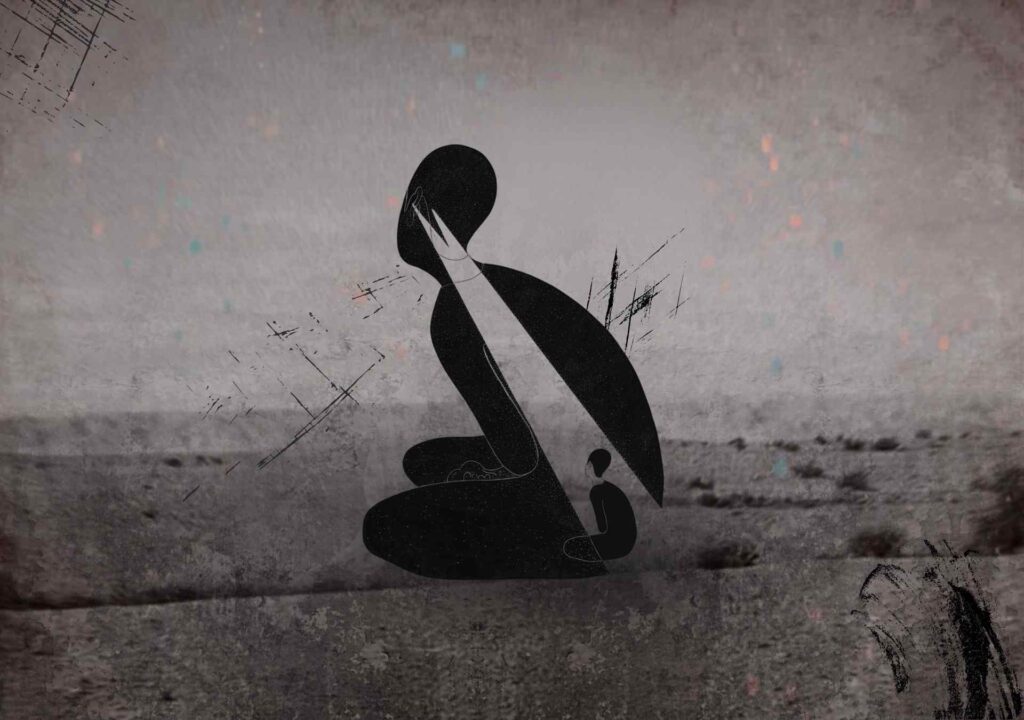
«Shelling was no longer distant—it entered inside, straight into the heart.»
— Juliana Al-Zughair
We came to know details we were never supposed to know—about people who had been living like us just days earlier, and who then became nothing more than stories told in fear. With every new report, something inside us quietly broke.
Then, suddenly, everything stopped.
The electricity went out, the internet disappeared, and the world became smaller than a single room.
Each person was trapped in their own area, and every area became a separate world—isolated, suspended, hanging on its fate.
We went to the market once, not only to buy supplies, but to see what was left. The shelves were eerily empty in a frightening way. Only cleaning products remained, as if life itself had withdrawn, leaving behind meaningless objects. Even bread had disappeared in a way that was hard to describe.
Vegetables vanished, and only tomatoes remained, standing alone as if they were witnesses to the absence of everything else.
We started going out into the street for one reason only: to charge our phones.
An unforgettable scene… the sidewalks turned into tangled charging cables, and we were all connected by a thin thread of hope: a battery that might last for a piece of news, reassurance, or another dose of fear.
Then came the night.
The night when we felt there would be no “later” after it.
The sound became closer, heavier, clearer.
Shelling was no longer distant—it entered inside, straight into the heart.
In that moment, there were no plans, no thoughts of escape, not even the ability to imagine an ending. There was only one question: how could it end?
I was at home with my mother, my sister, and my elderly grandmother.
My father had been absent for a long time.
I had experienced loss before. I had seen how it feels when the dearest person dies, and how it feels as if a part of you leaves with them. I had collapsed back then, and I thought that was the worst a person could go through.
But that night, I understood there is something even more painful:
not to lose someone again—but to wait for loss, to see it approaching, and have nothing you can do.
Helplessness has no voice, yet it suffocates.
To sit and wait—not ordinary waiting, but waiting for the end.
I thought about fleeing, but there was no escape. I saw people running from the window, while I could not move—not because I did not want to, but because there was no path. No one to protect us, no place to go, no plan.
I held my sister’s hand tightly, as if letting go meant losing her.
Tears filled our eyes, but even crying felt incomplete, as if what was happening was too large to be contained by tears.
In such moments, thoughts become strange and frightening, no longer resembling us.
Every possibility felt terrifying. Even the mind began searching for any ending, no matter how harsh, simply because it was faster than the unknown.
There was no heroism, no courage—only a human clinging to life in the weakest possible way, and with the strongest instinct.
That night, I understood something I will never forget:
that a human being, even when trapped in fear, broken and helpless, will still cling to life in a way that cannot be expressed—even if life itself is slipping through their hands.