
The Psychology of Massacres in Syria
This text is not an attempt to document massacres as mere numbers or passing events, but rather an effort to understand the long-term psychological and social impact left by years of repression and war within Syrian society.
The article begins from a question deeper than violence itself:
How does a massacre transform from an exceptional act into a recurring possibility?
And how is human being reshaped under fear, oppression, and sectarianism, until violence becomes part of everyday language and collective imagination?
Through a reading grounded in concepts from social psychology, the text seeks to approach the psychological structure that has led Syrians to live within a continuous cycle of fear and violence, where massacres do not only leave their mark on victims, but on society as a whole.
Massacres do not begin at the moment of gunfire; they begin much earlier...
— Maya Al-Abdoun
The massacre in Syria was never an exceptional event, but part of a long history of violence that has been produced and reproduced in different forms. Syria’s prolonged trajectory of violence includes decades of security repression since the 1980s, the beginning of the uprising, and the subsequent Syrian war, which resulted in mass killings, arrests, torture, and displacement, extending to the coastal and Suwayda massacres. In the Syrian context, the massacre is not merely a fleeting bloody act for its perpetrators; rather, it is a cumulative structure formed within society itself, nourished by fear, oppression, and the absence of justice.
A massacre, in its deeper meaning, is not only the killing of a large number of people at once, but a moment of complete collapse of the human being within the collective — a moment in which killing becomes a justifiable act, and the victim is reduced to a symbol of identity, sect, region, or political position, rather than an individual human being. For this reason, Syrian massacres cannot be understood as isolated security or military incidents. Violence in Syria is no longer merely a tool used by the state; it has gradually transformed into a social language and into part of Syrians’ collective imagination.
For a long period, Syria lived under a system governed by fear as a mode of rule. Massacres were carried out in silence and systematically concealed in the media, while their accounts circulated orally among people. Since documenting killing publicly was impossible, merely reporting the truth was enough to turn its bearer into another victim.
The post-2011 period created a radical shift in Syrians’ relationship with violence. Killing was no longer a hidden piece of news but became an everyday spectacle circulated in sound and image. Over time, documentation was no longer only a clandestine act; it sometimes became part of the crime itself.
As for the period after December 8, it revealed a more overt form of violence. The recent massacres, particularly those in the coastal region and then in Suwayda, exposed a dangerous transformation in the very form of violence itself.
The issue is no longer limited to the act of committing the crime, but also to its publicity. The large number of recorded videos emerging from the coast and Suwayda, along with the scale of violations circulated directly, demonstrated that the perpetrator no longer feels the presence of real fear of accountability. This is perhaps one of the most dangerous psychological and social outcomes produced by years of prolonged war: the collapse of both moral and legal punishment as effective deterrents.
One of the most dangerous consequences for societies that endure prolonged violence is not only the increase in the number of victims, but the normalization of violence itself. This normalization produces a form of collective emotional numbness, where society gradually loses its sensitivity toward tragedy, and violence becomes repeatable without the same moral shock.
In this context, Gustave Le Bon’s reading of “The Psychology of Crowds” appears particularly relevant to understanding mass violence. The individual within the crowd ceases to be an autonomous individual; personal responsibility dissolves within the collective, and rational thinking gives way to emotion, fear, and the desire for revenge. The crowd, especially in moments of tension and collapse, does not always act according to moral logic but rather according to emotional and instinctive logic, where rumors spread rapidly, the sense of threat is amplified, and the Other is transformed into an existential danger that must be eliminated.
In the Syrian case, years of war have produced communities living in a permanent state of fear, making any religious, sectarian, or regional difference potentially a direct source of threat. In such conditions, massacre becomes psychologically possible, not only militarily. When a group feels threatened, the killing of civilians can be justified within the collective imagination as “self-defense” or “protection of existence,” even when the victims are entirely outside any combat context.
However, explaining massacres solely through crowd psychology is insufficient. Here, the importance of Mustafa Hijazi’s concept of the “oppressed human being” emerges, where prolonged oppression does not only produce submission but also generates latent violence within individuals and societies. A sustained sense of helplessness, humiliation, deprivation, and loss of human value creates a psychologically burdened individual, incapable of confronting the true source of pain, who then begins to discharge this accumulated pressure elsewhere, often against those weaker than themselves.
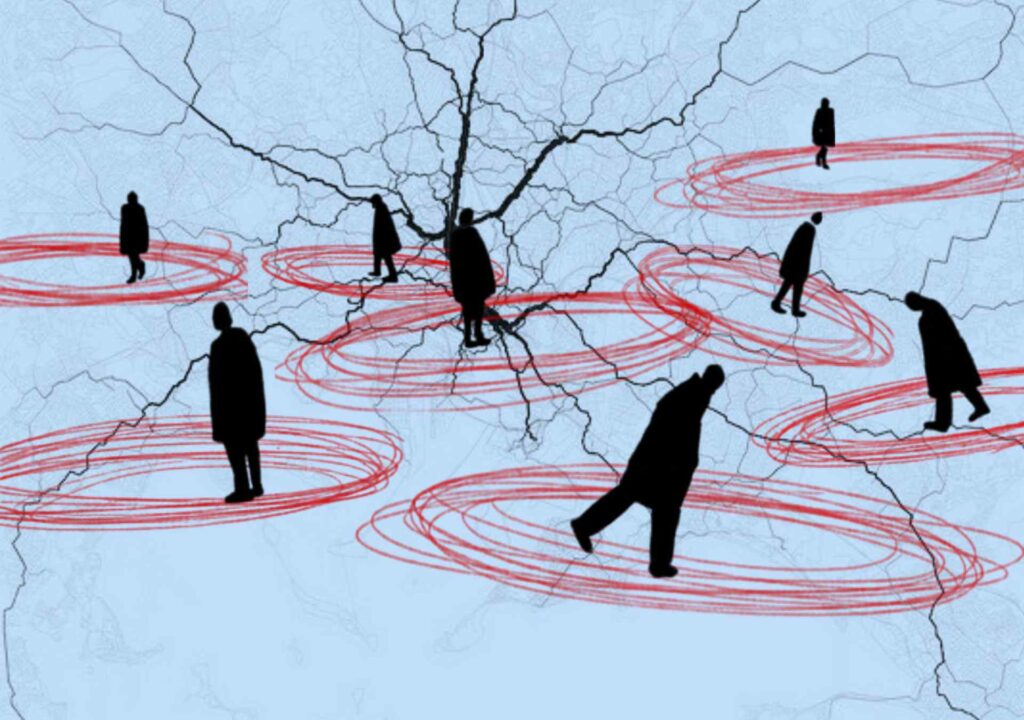
In this sense, the Syrian regime did not produce free citizens over decades as much as it produced individuals living within a permanent system of fear. With the collapse of state institutions and the fragmentation of society during the war, violence did not disappear but merely changed direction. Having been a vertical violence exercised by the state against society, it gradually transformed into horizontal violence among Syrians themselves. Instead of directing anger toward the structural source of oppression, it was displaced into sectarian, regional, and social fragmentation within the Syrian social body itself.
From here, sectarianism can be understood not only as an ideology of hatred but also as a collective mechanism of fear. In moments of collapse, individuals seek protective collectives, and sectarian or religious identity becomes a psychological refuge that offers a sense of security. However, collective identity is not only built on belonging but also on the construction of an “enemy.” Hence, in times of massacres, discourses such as “we are under threat,” “our existence is in danger,” and “either us or them” become widespread. These are not merely expressions of hatred, but of deep collective fear that becomes capable of justifying violence itself.
What happened in the coastal region after the fall of the regime and then in Suwayda does not only reveal the fragility of the new security landscape in Syria, but also exposes the profound psychological impact left by decades of authoritarianism and war within Syrian society. Massacres do not begin at the moment of gunfire; they begin much earlier — when the human being is reshaped under fear, oppression, and the absence of justice, and when society loses its capacity to perceive the Other as a fully human being.