Pain That Knows No Geography
Many Syrians carry within them a phrase we repeat through failed mornings and postponed ambitions: the vicious cycle. Yet in our reality, it is not merely a linguistic metaphor; it is the daily architecture of our lives — a sealed circle of exhausting labor that yields nothing but fatigue, of running after dreams suspended at the margins of influence, waiting for an opportunity from someone with wealth or power. With time, faces begin to resemble one another in their shared anticipation of something that may never come.
This is not the story of a grand event, but of a feeling that forms quietly — revealing how fear can seep into the smallest details of everyday life, and how safety, even if only for a fleeting moment, can redefine an entire place.
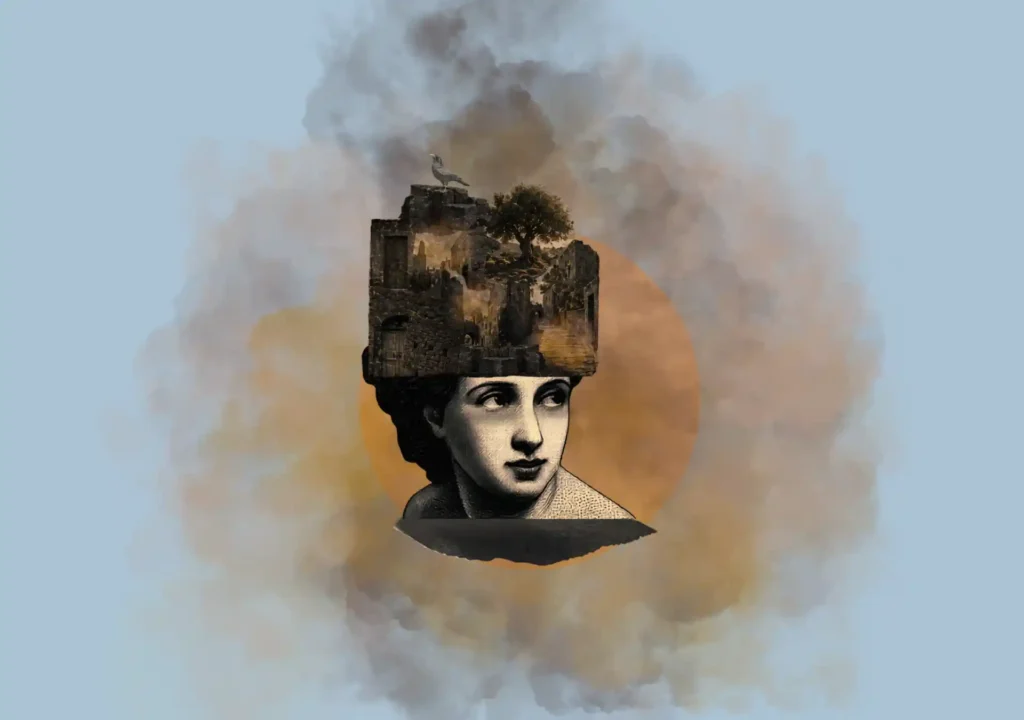
The pain I felt was not an abstract emotion, but the reflection of a fractured identity.
— Shams
Violence as a Greater Circle: When We Become Victims and Perpetrators
Before speaking of Sweida, we must first contemplate violence in its broader essence.
Violence is not merely a bullet or a scream. It is a climate that envelops existence when justice disappears.
It is the force that seeks to erase the other, reducing them to a mere “thing,” stripped of their humanity.
In Syria, violence is no longer an exceptional occurrence; for many, it has become embedded in the texture of daily life.
It seems that many of us have begun to incline toward violence in different forms — perhaps in our reactions, in our harsh judgments, or even in the silences we use to conceal our brokenness.
The greater tragedy is that, with what little consciousness we still possess, we struggle desperately not to become part of this cycle of violence, yet its details swallow us whole. We try not to be “violent,” while everything around us presses relentlessly against our dreams, our stability, and even our simplest right to feel safe.
This effort to remain gentle in the middle of a wilderness of brutality is, in itself, a daily battle — a battle to preserve whatever tenderness still survives within our souls against a world that shows no mercy.
On Sweida: When Violence Knocks on the Door of the Soul
Today, I stand before this cycle as a human being trying to understand an identity that exceeds geographical borders.
I constantly ask myself:
Who are we, as human beings, when our countries grow too narrow for us? Who are we, as Syrians, when our identity becomes nothing more than a reaction to catastrophe?
My belonging is not merely to the place where I was born. It is a comprehensive belonging, one that transforms the pain of any Syrian city into something intimately personal.
I am a daughter of Qamishli when hardship tightens around it.
I am a daughter of the coast when it drowns in its sorrow.
I am a daughter of Homs when it stood alone against killing and bombardment.
And today, with the full weight of my emotional being, I am a daughter of Sweida.
It was this sense of belonging that plunged me into shock and disbelief before the recent events in Sweida.
What I felt was not a passing reaction; it was an earthquake that shook the foundations of my emotional stability.
And when reports began to emerge of women being targeted and abducted, generalized anxiety transformed into something visceral — tangible, sharpened, immediate.
As a woman living in this place, I felt that the danger did not threaten “others” somewhere else; it threatened my own existence.
The abduction of women in Sweida is an attempt to steal safety from the eyes of all Syrian women.
And that is what made me experience survivor’s guilt — that cruel feeling of continuing the routines of ordinary life while others, somewhere else, stand face to face with danger.
A Letter from the Depth of Anxiety
Yes, danger stretches across the Syrian map. But in Sweida today, it feels more visible — and closer — than ever before.
The pain I felt was not a detached emotion. It was the echo of a fragmented identity.
How can I possibly be well when a part of me — living in Sweida’s homes and streets — trembles with fear?
These people are not strangers to me. What they endure reverberates through me; their anxiety spills into my days and my thoughts.
This is a message written from outside Sweida geographically, but from deep within it emotionally.
A message that says we refuse to let our lives remain nothing more than a vicious cycle of violence and waiting.
We need to break this circle — not through slogans alone, but through the profound recognition that our destinies are intertwined.
What happens in one corner of this country leaves its mark on everyone. And standing with Sweida today is inseparable from our humanity — from our collective right to live in a country where women do not fear the road, and men do not fear tomorrow.
Sweida will remain in my heart as an essential part of my broader Syrian identity — an identity that refuses fragmentation. And from the midst of my fear and anxiety, I send these words as testimony that, despite everything, we still feel — and we still refuse to grow accustomed to pain.